Optical sensing instrument startup
2025
LED-to-fiber coupling feasibility study
Tested whether added optics could push more LED light into a small optical fiber, and found the lower-cost answer.
- Illumination
- Freeform
- Fiber optics
- Simulation
Challenge
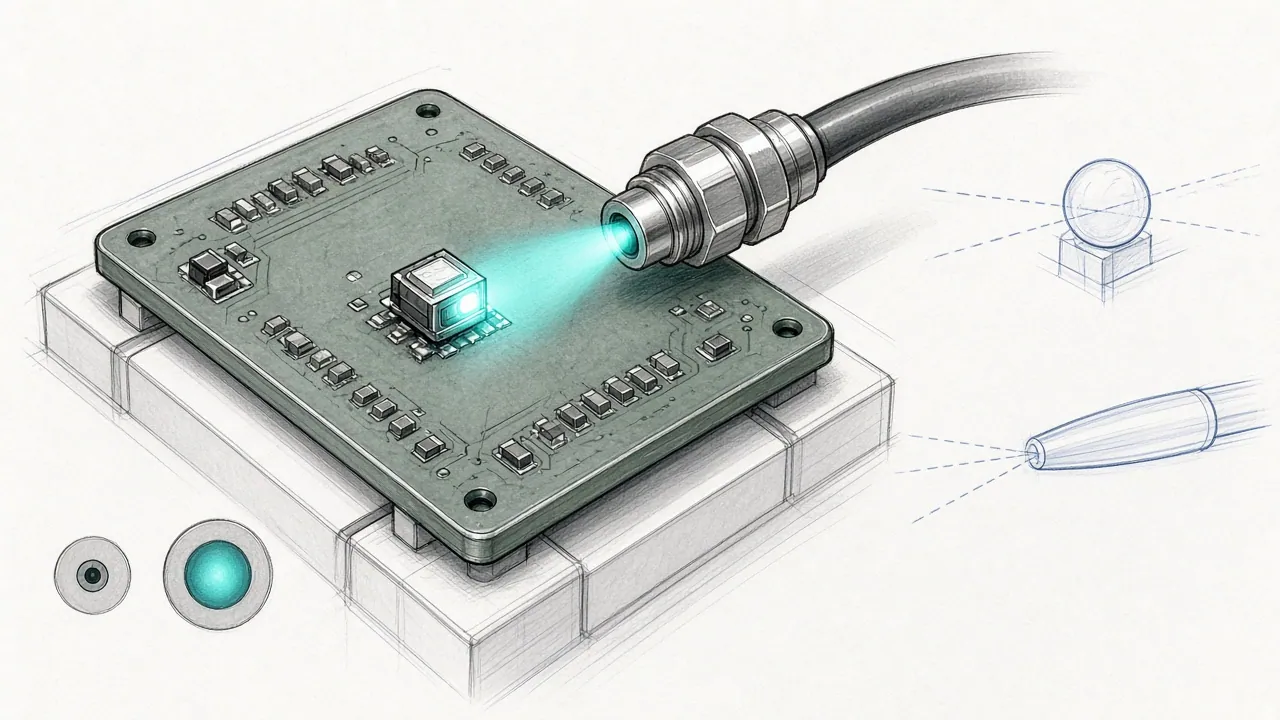
The client wanted more light from an LED into a small-core fiber. Direct coupling delivered only a few percent. Any added optic would add cost, so the gain had to be real.
Approach
We started with an etendue budget to bound what any optic could achieve. We then modeled lens trains, a freeform reflector, solid and fused tapers, and direct contact, first with an ideal source and then with the LED maker's measured ray data and a fiber model with the real numerical aperture. Two ray tracers were used to cross-check results.
Result
No added optic beat direct contact once the measured source and fiber acceptance were included, which spared the client the cost of a custom optic. The client moved to a larger fiber, which was the effective lever.
Key figures
~5% to ~40%
coupling efficiency by resizing the fiber instead of adding optics
4
optical concepts ruled out before any tooling
Tools
- Zemax OpticStudio
- TracePro
Related services: Illumination design, Zemax OpticStudio consulting, Stray light and non-sequential simulation.