Medical device startup (digital dermatology)
2026
Placement-tolerant optics for a smartphone dermatoscope
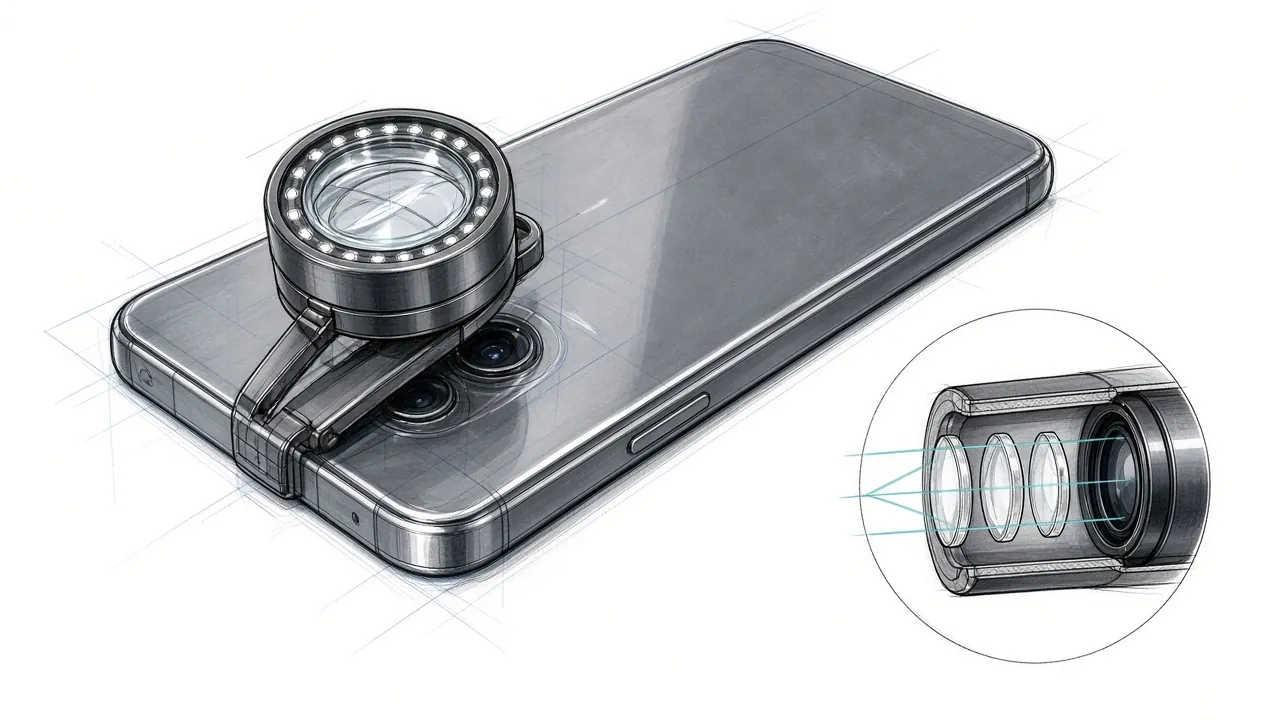
Redesigned a three-lens smartphone clip-on imager so it stays sharp when the phone is not seated perfectly.
- Imaging
- Optomechanics
- Simulation
- Stray light
- AI/ML
Challenge
The existing three-lens design lost image quality once the phone camera sat a fraction of a millimeter off center, and the outer field collapsed as that offset grew. Real users cannot seat a phone that precisely. Every mechanical interface, from lens thickness to the phone case, had to stay the same.
Approach
We traced the root cause to the phone aperture acting as a moving system stop, then re-optimized only the molded asphere shapes against a model with the phone deliberately misplaced. A Bayesian optimization campaign scored candidates directly on MTF instead of wavefront proxies. A ghost screen of the internal reflection paths, an AR coating decision, and a full structural-thermal-optical tolerance suite followed.
Result
Worst-case contrast across a sub-millimeter placement box improved about 100x while the barrel, retention, and case carried over unchanged. The adopted design passed the tolerance load cases.
Key figures
~100x
worst-case contrast under sub-millimeter phone misalignment
~300x
lower flare peak at the sensor
~15%
light throughput
Tools
- Zemax OpticStudio
- custom programs and scripts
Related services: Imaging lens design, Zemax OpticStudio consulting, Optomechanical design, Stray light and non-sequential simulation.